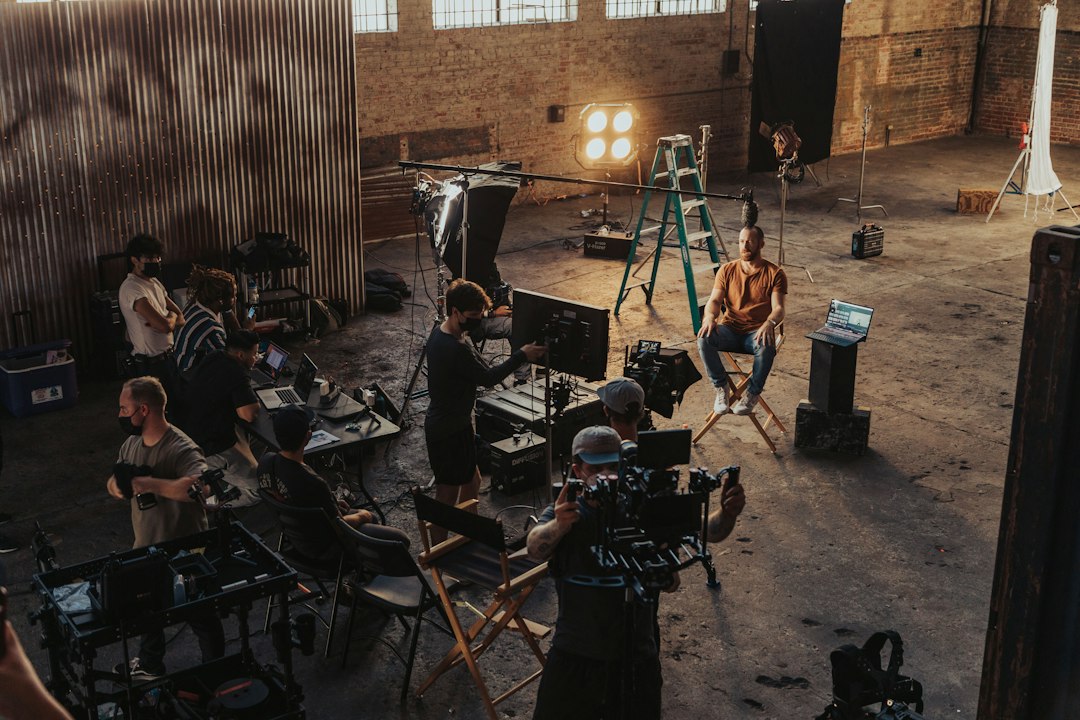
Photo by Jakob Owens on Unsplash
Practical Lighting: Why Filmmakers Use Real Light Sources
A practical light is any light source that appears in the frame and actually illuminates the scene. Table lamps, overhead fixtures, candles, neon signs, television screens, car headlights—if the audience can see it glowing and it contributes to the exposure, it’s a practical.
Cinematographers love practicals because they solve two problems at once: they motivate the lighting (explaining where the light is coming from) and they add production design detail that grounds the scene in a specific place and time. A single desk lamp can tell you whether a character is working late in a corporate office or holed up in a cheap motel.
Motivated Light and Visual Believability
Audiences don’t consciously notice lighting direction most of the time, but they feel when it’s wrong. A character sitting in a dark room shouldn’t be evenly lit from all sides. Practicals give the cinematographer a visible reason for the light to exist. The lamp in the corner justifies the warm glow on the actor’s face, even if a much larger hidden light is doing the heavy lifting just outside the frame.
This doesn’t mean practicals do all the work. Most household bulbs are too dim or too harsh to expose a scene properly on their own. The desk lamp might be a 40-watt LED, but the cinematographer places a 2K tungsten light just behind it, matching the color temperature and angle so the practical appears to be the source. The trick is making the motivated light feel consistent with what the audience sees glowing on screen.
Depth and Separation
Practicals add layers to the image. A single overhead key light can flatten a scene, but scatter a few practicals in the mid-ground and background—a street lamp through the window, a strip of under-cabinet LEDs in the kitchen, a glowing exit sign down the hall—and suddenly the frame has depth. The light sources create separation between foreground, mid-ground, and background, guiding the viewer’s eye and giving the space dimensionality.
Roger Deakins uses practicals relentlessly to build atmosphere while keeping the lighting naturalistic. In Blade Runner 2049, nearly every interior has visible sources: wall panels, monitors, ceiling fixtures, all contributing to the scene’s color and mood. The practicals aren’t just decoration—they’re the scaffolding for the entire lighting scheme.
Practical Problems
The biggest challenge is control. A candle flickers unpredictably. A TV screen changes brightness shot to shot. A car dashboard might be too blue or too dim to read on camera. Cinematographers often swap out the actual bulbs for higher-wattage or color-corrected versions, or they rig dimmers so the practical can be adjusted on the fly. Sometimes the visible bulb is turned off entirely and a hidden light mimics it, because the real thing just doesn’t work.
LED technology has made practicals more flexible. Modern RGB LED bulbs can be programmed to any color temperature and dimmed remotely, which means a single practical can shift from warm tungsten to cool daylight between takes without anyone touching it. Production designers now build sets with embedded LED strips and panels that function as both set dressing and controllable light sources.
When to Reach for a Practical
Practicals work best when the scene demands a strong sense of place or a specific mood. A noir interrogation room needs a single hanging bulb. A late-night diner needs the overhead fluorescents and the glow of the neon sign outside. A bedroom lit only by the blue wash of a television feels lonely in a way that no off-camera light could replicate.
The choice to use practicals is as much about storytelling as technique. They anchor a scene in a physical reality, and when used well, they make the lighting feel invisible—not because it isn’t noticed, but because it belongs exactly where it is.