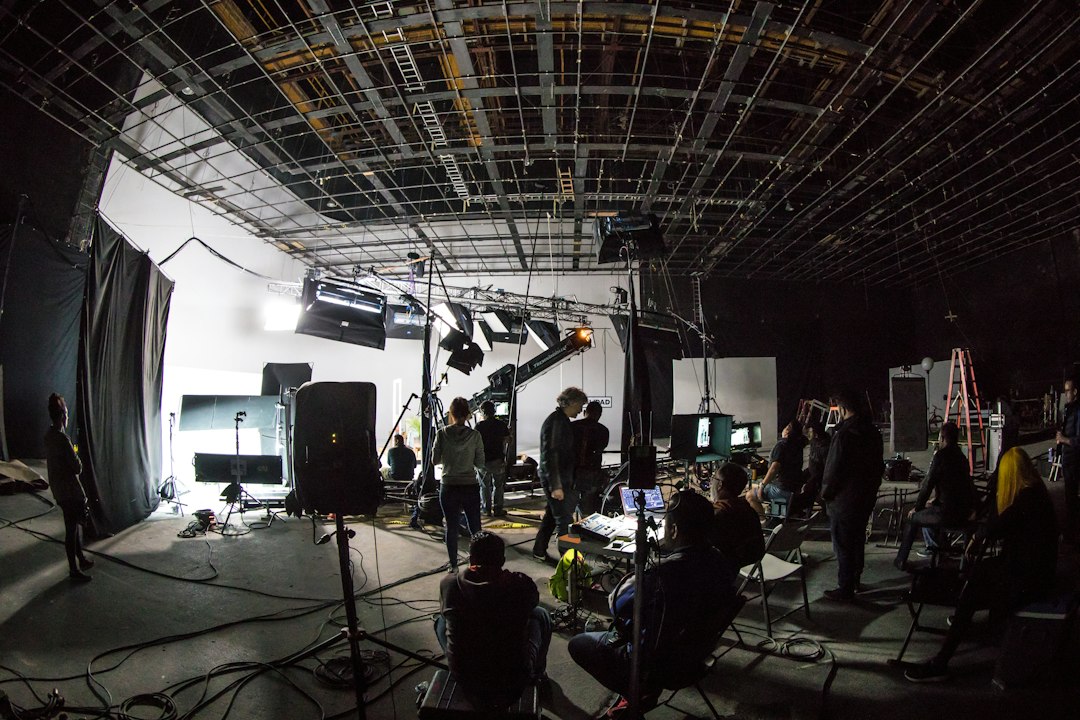
Photo by Brands&People on Unsplash
Why Film Sets Use "Peas and Carrots" for Background Dialogue
Walk onto any film set during a restaurant scene, a crowded office, or a busy street exterior, and you’ll notice something strange: dozens of background actors are moving their mouths, but they’re all silently mouthing variations of the same absurd phrase. “Peas and carrots, peas and carrots.” Sometimes “watermelon cantaloupe” or “rhubarb rhubarb.” They look like they’re having animated conversations, but they’re actually reciting produce.
This isn’t a hazing ritual or an inside joke. It’s a deliberate technique designed to solve a fundamental problem in filmmaking: how to create the visual impression of a bustling, populated environment without ruining the actual dialogue.
The Problem with Real Background Chatter
When background actors—often called “extras” or “background talent”—improvise real conversations during a take, they create unintended problems. First, their voices can bleed into the principal actors’ dialogue tracks, making it harder for sound mixers to isolate the performances that matter. Even if background actors speak quietly, sensitive boom microphones and lavalier mics will pick up fragments of their speech.
Second, if background actors say anything intelligible, it can accidentally create legal or creative complications. A background actor who ad-libs “Did you see that new Marvel movie?” has just dropped a trademarked property into the film’s audio. An actor who says something offensive, even quietly, can create a post-production nightmare if the mic catches it. And if someone happens to say a line that sounds too similar to the scripted dialogue, it can confuse editors during the cutting process.
Why These Specific Phrases Work
“Peas and carrots” became the standard because of how the words look when spoken. The phrase requires distinct mouth shapes—open vowels, visible consonants—that read clearly on camera as speech. When an actor silently mouths “peas and carrots” on a loop, their lips and jaw move in a way that convincingly mimics natural conversation.
The phrase is also rhythmically neutral. It doesn’t lock actors into a single cadence. Background performers can vary their speed, add pauses, and change their inflection to match the energy of the scene. A tense courtroom drama calls for slow, measured “peas and carrots.” A chaotic party scene gets rapid-fire repetition.
Other phrases serve the same function. “Watermelon cantaloupe” offers a similar visual rhythm. British sets sometimes use “rhubarb rhubarb,” which has been a theater standard for centuries. The specific words don’t matter—what matters is that they’re safe, non-distracting, and give the appearance of speech without creating actual recordable sound.
When Background Actors Do Speak
Not every scene uses silent mouthing. In some cases, the production wants ambient noise—a low murmur of crowd sound that will be mixed into the final audio. When this happens, background actors are given “walla” direction: they’re told to speak quietly and indistinctly, creating a wash of human sound without clear words.
Walla is often recorded separately in post-production by loop groups—professional voice actors who specialize in crowd noise. This gives the sound team precise control over volume, tone, and content. But on set, if background actors are asked to create walla live, they’ll still avoid saying anything specific. Instead, they’ll improvise soft, overlapping nonsense syllables that blur together into the impression of conversation.
A Hidden Layer of Craft
The “peas and carrots” technique is one of those invisible crafts that disappears into the final product. When you watch a scene set in a packed restaurant or a busy hospital corridor, you’re not supposed to notice that every background actor is silently repeating the same phrase. You’re supposed to believe the space is alive with dozens of simultaneous conversations.
It’s a small detail, but it reflects a broader truth about filmmaking: every element, no matter how minor, is engineered for control. Nothing is left to chance. Even the conversations you can’t hear have been carefully designed to say nothing at all.