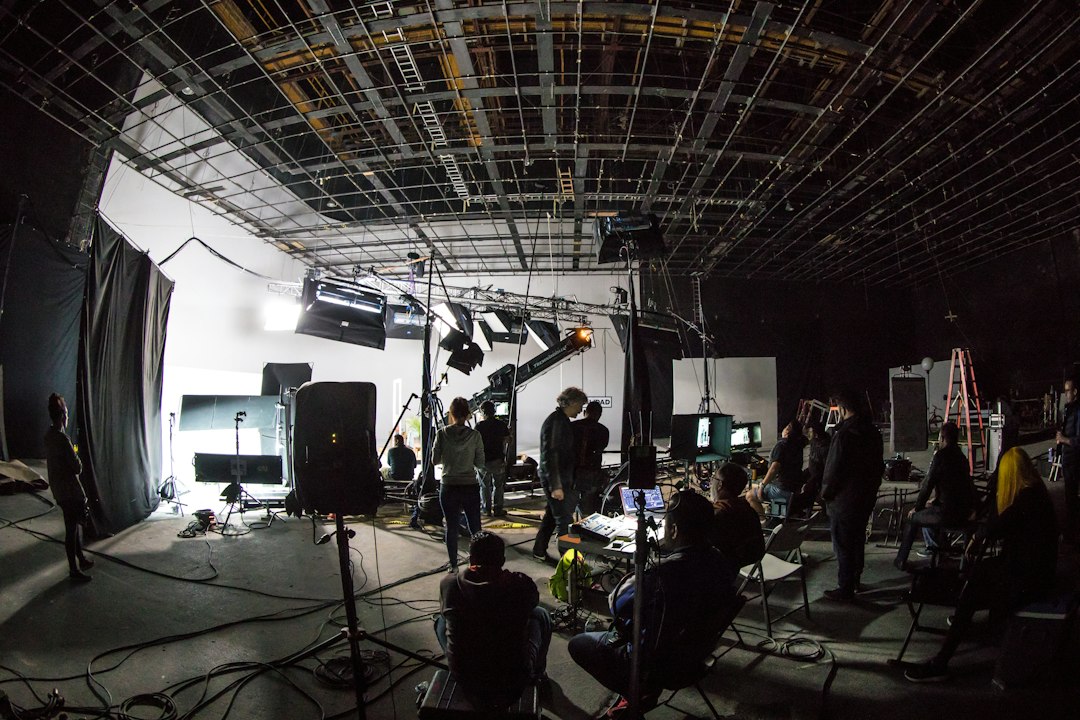
Photo by Brands&People on Unsplash
Painting With Light: How Cinematographers Build Scenes Around Practical Sources
The best-lit scenes in cinema don’t look lit at all. They look like light simply exists in the world of the story. That’s because great cinematographers practice an approach often called “painting with light”—designing the image around visible, motivated light sources that become part of the composition itself.
This isn’t the same as practical lighting, where real fixtures provide the illumination. This is about making light sources into compositional elements: windows streaming sunlight, table lamps pooling warm glows, neon signs casting colored spills. The light source becomes part of what you’re looking at, not just what you’re looking with.
Why Visible Sources Matter
When a light source appears in frame, it does double duty. It explains where light is coming from, satisfying our instinct for visual logic. But it also acts as a compositional anchor—a bright element that draws the eye, establishes mood, and structures the geometry of the shot.
A character standing near a window isn’t just well-lit. The window itself becomes a frame-within-a-frame, a secondary shape that competes with or complements the human figure. A desk lamp in the corner of a noir office isn’t just ambient fill—it’s a pool of warmth in surrounding darkness, a visual cue about isolation or late-night obsession.
This approach also grounds the image in physical reality. When you see where light is coming from, the scene feels like a place rather than a set. Shadows have direction. Highlights have explanation. The world holds together.
Building the Scene Around the Source
Cinematographers who paint with light start with the question: where would light naturally exist in this space? Then they build the blocking, camera angle, and framing to showcase that source.
A breakfast scene might be staged so morning sun rakes across the table from a side window, putting one character in warm light and another in relative shadow. The window itself sits at the edge of frame, visible but not centered—a reminder of the world outside while the drama unfolds inside.
A nighttime interrogation might place a single overhead fixture dead-center in a wide shot, turning it into a harsh focal point. Characters move in and out of its circle of influence. The light becomes a character itself, oppressive and clinical.
In both cases, the light source isn’t hidden behind the camera or flagged out of frame. It’s part of the shot’s architecture.
Controlling What You Show
Of course, the visible sources are rarely doing all the work. A window in frame might be bright and beautiful, but the actual exposure on the actor’s face comes from a massive diffusion frame just outside, shaping and softening the raw sunlight. A period-accurate candle might flicker on-camera while a carefully gelled spotlight does the real lifting from above.
The art is in balance. The source needs to feel powerful enough to justify the light in the scene, but the cinematographer still controls intensity, direction, and color with hidden instruments. The audience believes the window is lighting the room. The DP knows it’s the 20-by-20 silk and the HMI bounced into it.
This is why production designers and cinematographers work so closely. The designer places windows, chooses practicals, and builds spaces with light in mind. The DP then exploits those choices, framing and exposing to make the sources sing.
The Difference It Makes
When you watch a scene that feels visually rich but can’t quite pinpoint why, look for the light sources in frame. Chances are the cinematographer has given you something to look at—not just something to see by. The interplay of bright and dark, the shape of a lamp or the glow of a screen, the way a sliver of doorway light cuts across a face.
Painting with light isn’t about realism for its own sake. It’s about making light into composition, turning illumination into narrative. Every source in frame is a choice about mood, focus, and the emotional texture of the space. The light doesn’t just reveal the scene. It helps tell the story.