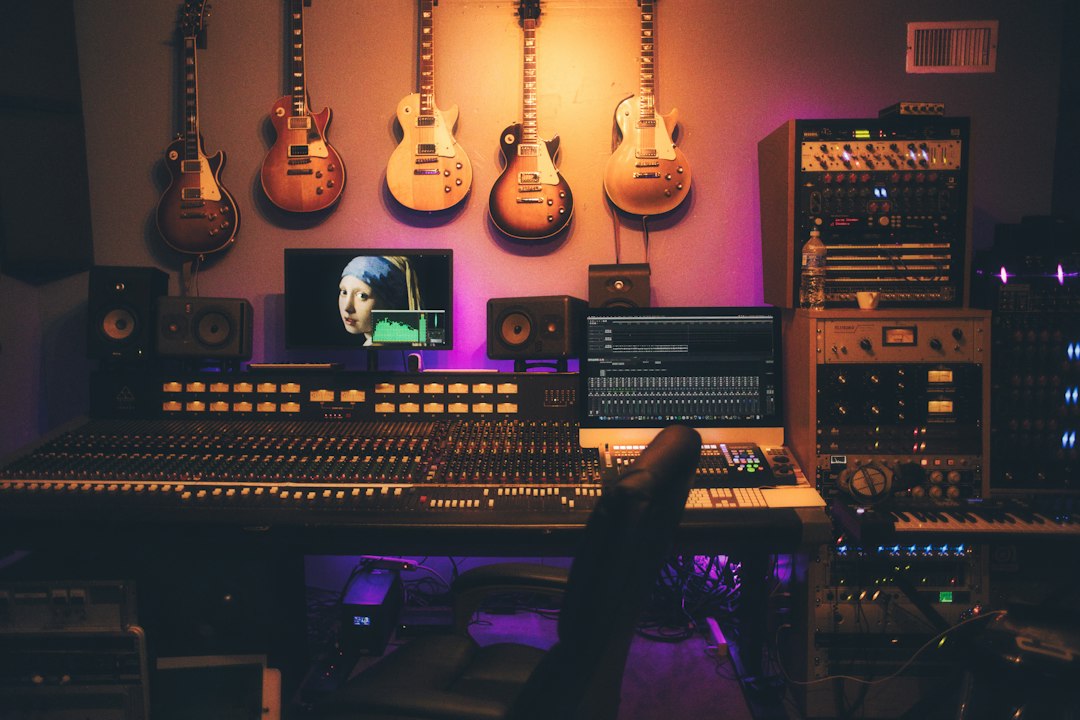
Photo by Caught In Joy on Unsplash
Why Movie Gunshots Sound Different Indoors and Out
When a gun fires in a movie, your brain does more than just register the bang. It listens to how that sound behaves in space—how it bounces, decays, and fills the room. A gunshot in a concrete parking garage sounds completely different from one fired in an open field, and sound designers exploit this difference to ground action scenes in physical reality.
The technical term is acoustic space, and it’s one of the most powerful tools in a sound designer’s kit. Every environment has its own sonic signature based on the surfaces around it, the volume of air, and how sound waves reflect or absorb. When filmmakers ignore these signatures, gunfire feels flat and fake. When they get it right, the audience unconsciously believes the space is real.
Why Reverb Matters for Gunshots
Reverb is the trail of reflections that follows a sound. In a small bathroom with tile walls, a gunshot would produce a sharp, dense reverb with a quick decay—lots of hard surfaces mean lots of rapid reflections. In a cathedral, that same shot would bloom into a long, smooth tail as sound bounces off distant stone walls and vaulted ceilings.
Sound designers start with a clean gunshot recording, often captured on a range or in a controlled environment, then sculpt it with reverb plugins or convolution processors that mimic real spaces. They might layer multiple reverb types: early reflections for the immediate environment, a longer tail for the larger space, and sometimes a pre-delay to simulate the distance between the gun and the nearest reflecting surface.
The goal is not realism in the documentary sense—it’s perceptual realism. A gunshot outdoors in an open field has almost no reverb, just a sharp crack followed by silence or distant echoes. Indoors, especially in tight quarters, the reverb is dense and aggressive, signaling danger and confinement. The sound tells you how much room the characters have to move.
The Contrast Between Interior and Exterior
One of the most common mistakes in low-budget action films is using the same gunshot sound effect for every location. A gunfight that moves from a hallway to a rooftop should not sound the same. The shift in reverb is part of the storytelling—it tells the audience the characters have escaped into open air, or moved deeper into a maze of rooms.
In skilled hands, this contrast becomes a narrative tool. A confined shootout might feature tight, percussive gunshots with rapid-fire reflections that heighten claustrophobia. When the action spills into an open street, the reverb drops away, and the shots sound stark and exposed. The absence of reverb becomes as meaningful as its presence.
Sound designers also consider perspective. If the camera is close to the shooter, the gunshot is loud and present, with reverb that feels immediate. If the camera is across the street, the sound is thinner, more distant, with reverb that emphasizes the space between observer and action. The acoustic treatment changes with every shot angle.
Layering for Complexity
Real gunshots are messy. They have a crack, a boom, a mechanical clatter, and sometimes a ringing echo. Film gunshots are often built from multiple layers: the initial transient for impact, a low-frequency rumble for weight, and a reverb tail shaped to the space. Some sound designers add subtle details like the sound of a shell casing hitting a specific floor type—wood, metal, concrete—to further anchor the gunfire in a tactile environment.
The reverb itself might be a blend of synthetic processing and recorded impulse responses from real locations. A designer might capture the acoustic signature of an actual warehouse or stairwell, then use that recording to process the gunshot, ensuring the reverb matches the visual space on screen.
When done well, the audience never consciously notices. They simply feel the space, the danger, and the physics of the moment. That’s the quiet power of acoustic space in film sound—immersion without announcement.