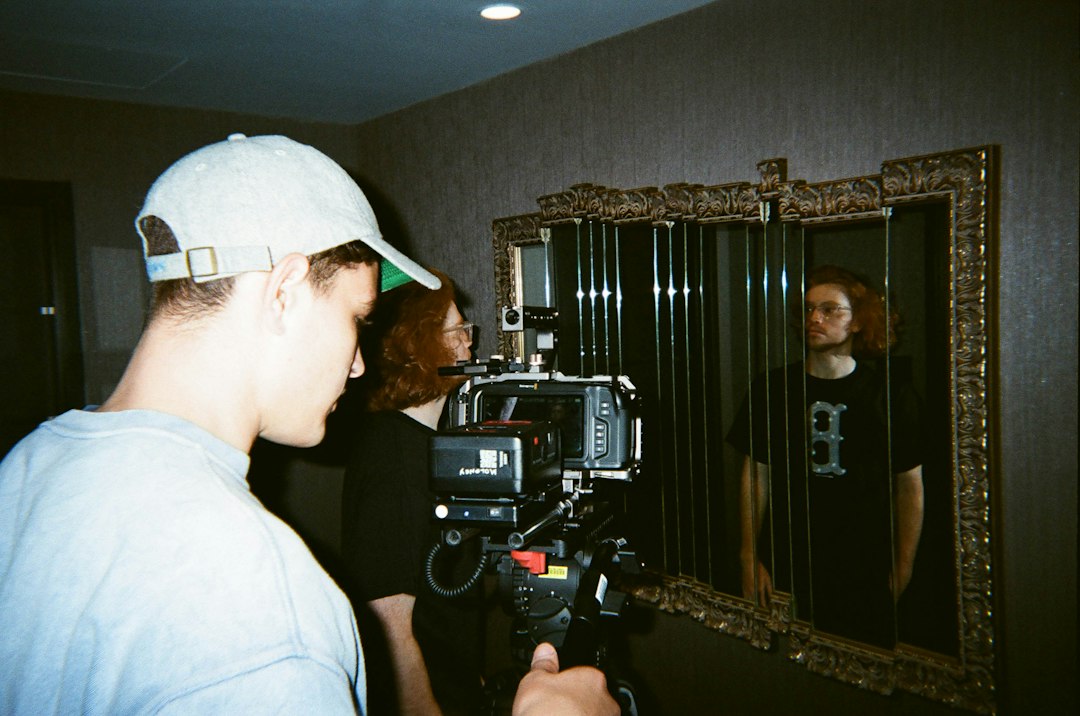
Photo by Matthew Moloney on Unsplash
Why Movie Mirrors Never Show Cameramen: The Craftsmanship of Reflection Control
The Invisible Problem
Every mirror in a film set presents the same basic challenge: mirrors reflect everything in front of them, including the expensive camera equipment and crew that shouldn’t exist in the story’s world. Yet characters regularly check their appearance, talk to reflections, and move through spaces lined with glass. The audience almost never notices the missing crew because cinematographers have developed a toolkit of techniques that make the impossible shot look effortless.
The Angle Is Everything
The simplest solution is geometry. Most mirror shots are carefully composed so the camera sits just outside the reflection’s sightline. If a character stands at a bathroom sink looking straight ahead, the camera can shoot from a 30 or 40-degree angle to one side, capturing both the character and their reflection without appearing in the glass itself. The frame feels frontal to the viewer, but the actual camera position is off-axis enough to stay hidden.
This technique requires precision. A few degrees too far in one direction and the shot feels awkward or compositionally weak. A few degrees the other way and the camera barrel edges into frame. The cinematographer and director work out these angles during blocking, sometimes using a stand-in mirror or even a smartphone camera to preview what the reflection will actually capture.
The Almost-Mirror
Sometimes what looks like a mirror isn’t reflective at all. When a shot requires the camera to be directly in the reflection’s path, crews will remove the mirror entirely and build the “reflection” as a separate matching set on the other side of the frame. The actor performs in the real space while a double, dressed and lit identically, performs the same actions in the mirror space. Both sides of the frame are live action, just two separate pieces of reality composited together by careful coordination.
This technique becomes especially useful when the reflection needs to behave differently from reality—showing a vampire with no reflection, revealing something the character doesn’t see, or creating a dream-logic moment where the reflection acts independently.
Shooting Through the Glass
Another approach places the camera on the far side of the mirror, shooting through it toward the actor. This requires the mirror to be replaced with clear glass or removed entirely during the shot. The reflection effect gets added in post-production by flipping and compositing footage of the actor. From the audience’s perspective, they’re seeing someone look into a mirror, but the technical reality is a camera looking through empty space at a performer.
This method gives directors freedom to move the camera through the plane of the mirror or push in on a reflection without worrying about rigging or crew visibility.
Controlling the Reflection
When a real mirror stays in frame, grip and electric crews meticulously control what appears in it. They position lights, flags, and equipment outside the reflection’s angle. They dress the reflected space as carefully as the main set, ensuring no light stands, cables, or crew members accidentally catch the glass. On large mirrors or reflective surfaces like windows, teams sometimes apply dulling spray or gels to specific areas, subtly reducing reflectivity just enough to hide problem spots without making the effect obvious.
Camera operators also use longer lenses to compress space, making it easier to keep equipment out of reflection range while still capturing an intimate frame.
Why It Matters
These techniques do more than solve a technical problem. They preserve the audience’s immersion in the story. A visible camera shatters the fourth wall instantly, pulling viewers out of the narrative to remind them they’re watching a constructed piece of fiction. The craft lies in making what’s technically difficult appear natural and unconsidered, letting the mirror exist as a simple narrative element rather than a special effect.
The next time you watch a scene built around a bathroom mirror or a hallway lined with glass, pay attention to the angles and what you can’t see. That invisible craftsmanship is dozens of people solving geometry problems in real time.