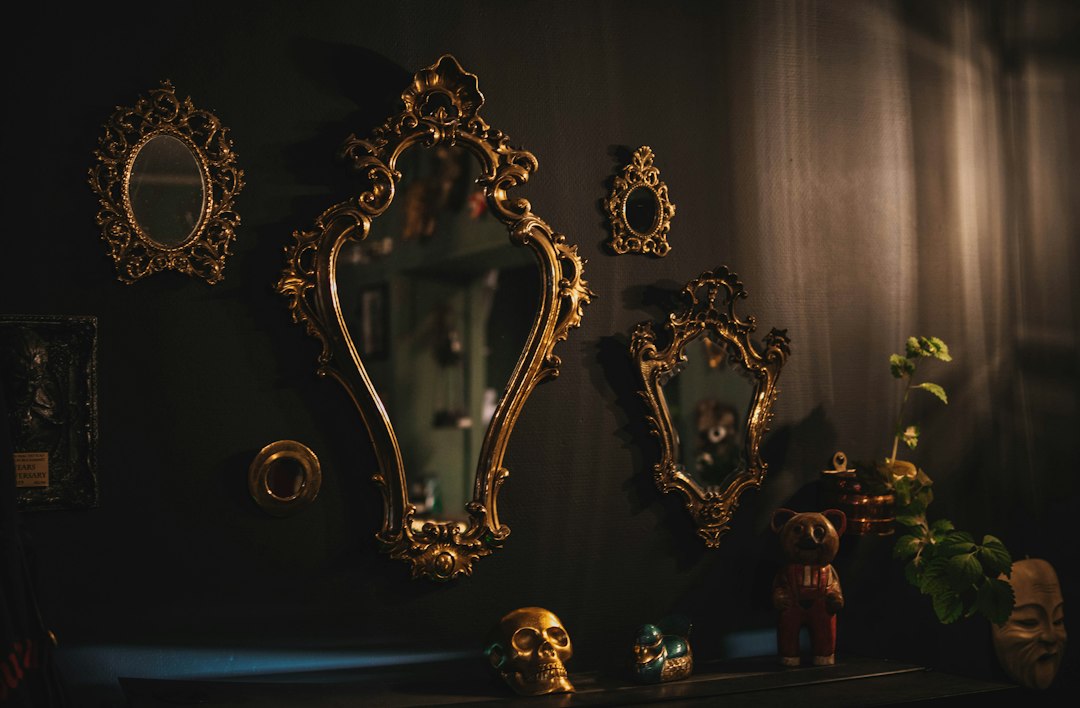
Photo by Tuva Mathilde Løland on Unsplash
Why Movie Mirrors Never Show Camera Crew
Every mirror in a film presents the same technical problem: cameras, lights, boom mics, and crew members should all appear in the reflection, yet they almost never do. This isn’t an accident or movie magic. It’s careful choreography that uses angles, blocking, and sometimes clever trickery to keep the illusion intact.
Shooting Through the Gap
The most common solution is simply keeping the camera just outside the mirror’s reflection angle. Cinematographers position the camera so it captures the actor looking into the mirror without the camera itself appearing in frame. This requires precise placement—often the camera sits at the edge of the mirror’s sightline, shooting at a shallow angle.
The actor’s eyeline has to match what the audience expects to see. They can’t actually look at their own reflection because that would mean looking directly at the lens. Instead, they look slightly off to the side, at a point where their reflection would naturally appear while the camera stays hidden in the margin.
This technique works best with smaller mirrors or when the shot frames only part of the reflection. The wider the mirror, the harder it becomes to hide.
Blocking Actors and Lights
When a scene demands that an actor stand directly in front of a mirror, filmmakers adjust the blocking so the reflection shows only what’s needed. The actor might stand slightly to one side. The camera shoots from a corresponding angle that keeps crew and equipment in the blind spot.
Lighting gets complicated fast. Large soft sources and diffused lights tend to show up as bright patches in reflections. Cinematographers either position lights outside the mirror’s reflection range or use smaller, more directional sources that can be flagged off. Sometimes they’ll light the actor’s face from below or from the side, relying on bounce and ambient sources rather than visible fixtures.
In scenes where a character leans close to a mirror—adjusting makeup, examining their face—the camera often sits low or high, shooting at an angle steep enough to stay out of view while still capturing the intimacy of the moment.
The Twin and the Set Trick
Some mirror shots don’t use mirrors at all. When a filmmaker wants a sustained, perfectly symmetrical mirror shot with no risk of revealing the camera, they build a fake mirror frame and place the camera where the mirror should be. On the other side, they construct a matching set—a mirror image of the room.
The actor performs on one side while a double, identically dressed and lit, performs on the other. The camera shoots through the empty frame, capturing both “sides” of the mirror at once. What looks like a reflection is actually two live performers in symmetrical spaces.
This technique is expensive and time-consuming, but it allows for complex choreography and sustained shots that would be impossible with a real mirror.
Green Screen and Composite Reflections
Digital compositing offers another path. The mirror is covered with green or blue fabric, or replaced entirely with a tracking marker setup. The actor performs the scene, and the reflection is added in post-production.
The crew shoots a clean plate of the actor’s reflection separately—sometimes with the actor performing in front of a greenscreen, sometimes by shooting them from the reverse angle and flipping the image. Compositors then track the reflection into the mirror, matching lighting and perspective frame by frame.
This approach gives complete control but requires extra time in post and careful attention to interactive lighting. If the mirror should reflect a practical light source, that has to be accounted for or the illusion falls apart.
Why It Matters
Mirrors force filmmakers to think spatially in reverse. Every decision about camera placement, actor blocking, and lighting has to account for what bounces back. The solutions aren’t always elegant—sometimes they’re awkward compromises—but when done right, the audience never notices the problem existed at all.
That invisibility is the goal. A mirror should feel like a mirror, not a puzzle the filmmakers barely solved. The best mirror shots are the ones where you forget to wonder how they pulled it off.