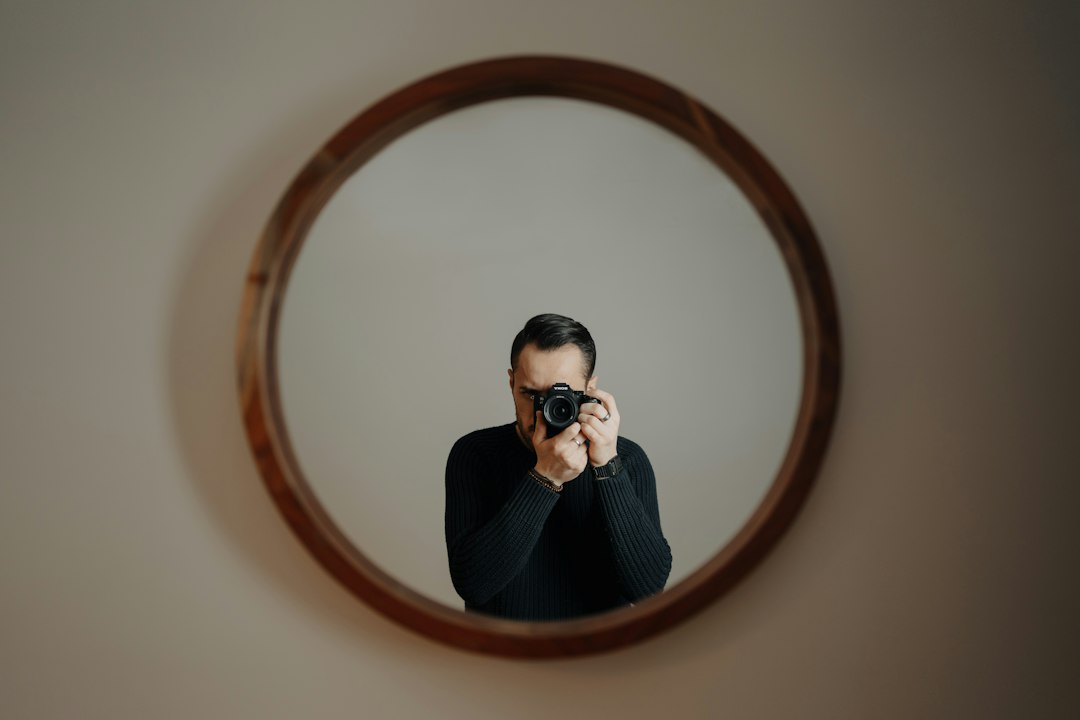
Photo by Andrik Langfield on Unsplash
Why Movie Mirrors Never Show the Camera
Every time a character looks into a mirror on screen, you’re watching a small act of cinematic sleight-of-hand. The reflection shows exactly what it should—the character’s face, the room behind them—but never the camera pointed directly at the glass, never the boom mic hovering overhead, never the cinematographer and crew standing just out of frame. This isn’t an accident. It’s the result of careful planning, precise positioning, and sometimes outright trickery.
The Angle Is Everything
The simplest solution is geometry. Cinematographers position the camera just outside the mirror’s reflection angle, shooting from a spot where the camera itself won’t appear in the glass. This works when the mirror is angled slightly away from perpendicular to the camera, or when the mirror is positioned so that it reflects something other than the camera’s position—usually the actor standing beside where the camera actually sits.
The actor looks into the mirror as if they’re looking at themselves, but the reflection shows them from an angle that’s just offset enough to keep the camera out of frame. To the audience, it reads as a straight-on reflection. The trick relies on the fact that we don’t scrutinize the physics of mirror angles while watching a scene. We accept what we see.
The Mirror Isn’t a Mirror
Sometimes the mirror is replaced entirely. When a scene requires a character to stand directly in front of a mirror and look straight into it, the “mirror” might be an empty frame with the camera shooting through it. What you see in the “reflection” is actually the camera’s view of the actor on the other side, composed and lit to match the room.
The actor performs on both sides of the frame—once as themselves, once as their reflection—or a double stands in. Set dressing is mirrored on both sides so the background matches. The illusion holds as long as the lighting, the blocking, and the performance sync up. The technique is more common than you’d think, especially in bathroom or vanity scenes where a character leans close to the glass.
Digital Removal in Post-Production
When practical techniques aren’t enough, the camera is simply painted out in post-production. The shot is filmed with the camera visible in the reflection, then visual effects artists digitally remove it frame by frame, replacing the camera and crew with a clean plate of the background or an extension of the environment.
This approach is more expensive and time-consuming, so it’s typically reserved for complex shots where no other method works—like a 360-degree pan around a room full of mirrors, or a moving shot that makes consistent camera placement impossible. Modern compositing tools have made this more feasible, but it’s still preferable to solve the problem on set when possible.
CGI Reflections
In some cases, the entire reflection is computer-generated. This is particularly common in heavily stylized or fantastical sequences where the reflection doesn’t match reality—think a character seeing a distorted version of themselves, or a mirror revealing something that isn’t there. But even in mundane scenes, a digitally created reflection can solve unsolvable logistical problems, especially in tight spaces or complex choreography.
The advantage is total control. The disadvantage is cost, and the risk that a synthetic reflection won’t quite feel photographically real. Small mismatches in lighting, motion blur, or depth of field can make the shot feel off, even if the audience can’t articulate why.
Why It Matters
The goal of all these techniques is the same: preserve the illusion. A visible camera or crew member shatters the fourth wall and pulls the audience out of the story. Mirrors are everywhere in real life, and they’re powerful tools for visual storytelling—they reveal character, create depth, add visual interest. But they’re also one of the most technically challenging elements to shoot convincingly.
The fact that you rarely notice the workaround is proof that it’s working. The next time you watch a mirror scene, pay attention to the angle, the framing, the way the actor’s position doesn’t quite line up with what the reflection should show. You’ll start to see the seams. But you’ll also appreciate the craft that keeps those seams invisible.