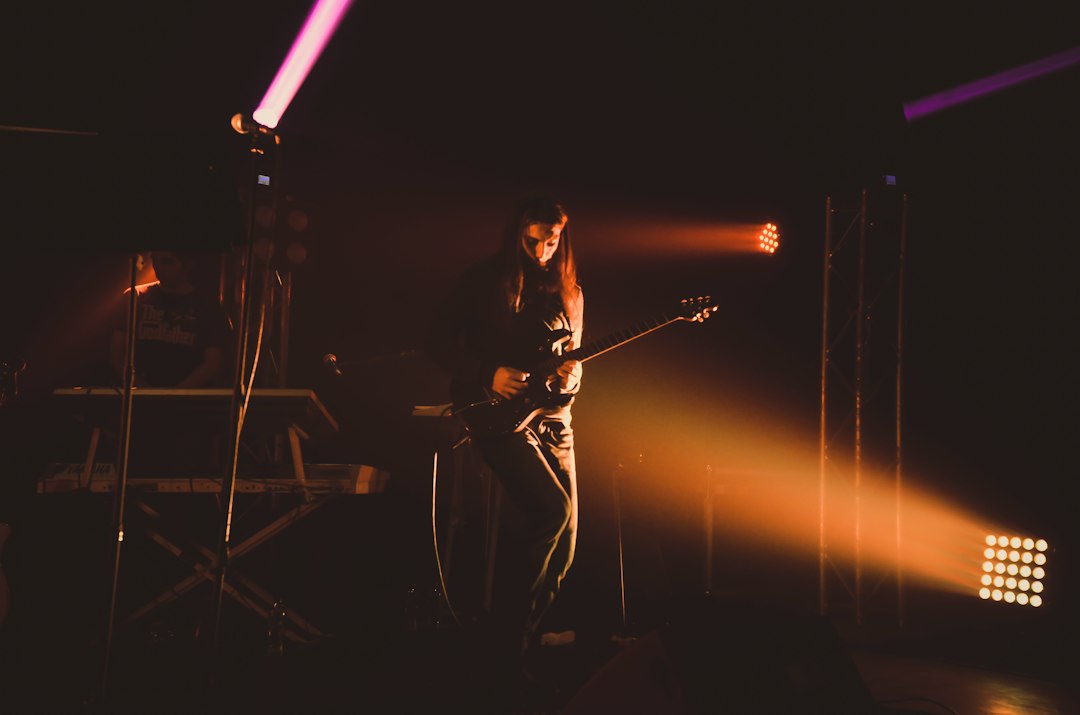
Photo by Sam Moghadam on Unsplash
Why Film Sets Use Haze and Atmosphere
Walk onto almost any professional film set and you’ll notice something in the air—literally. A faint haze hangs in the space, softening the light and making beams visible as they cut through the frame. This isn’t accidental fog from a broken machine or poor ventilation. It’s atmosphere, carefully controlled and deliberately introduced by the cinematography team to sculpt light and enhance the image.
Making Light Visible
The primary reason cinematographers use haze is to reveal light itself. In a perfectly clear environment, light is invisible until it hits a surface. A shaft of sunlight streaming through a window, a car’s headlights piercing the darkness, or a single practical lamp in a dim room—all of these exist as abstract concepts until something scatters the light and makes the beam visible to the camera.
Haze consists of fine particles suspended in the air that catch and scatter light. When a cinematographer introduces controlled atmosphere, suddenly every light source gains dimension. Volumetric beams appear. Backlight glows. Shafts of light become compositional elements in their own right, adding depth and texture that would otherwise be invisible.
Creating Depth and Separation
Atmosphere doesn’t just reveal light—it creates spatial depth through a principle called aerial perspective. As light travels through haze, distant objects appear slightly softer and lower in contrast than foreground elements. This mimics how our eyes perceive depth in the real world, where atmospheric particles naturally create separation between near and far.
On set, this means a character in the foreground remains sharp and punchy while the background gently recedes. The effect is subtle but powerful, helping the audience’s eye understand the three-dimensional space of a scene captured on a two-dimensional screen. It’s especially valuable in large locations or when shooting with longer lenses that can otherwise flatten perspective.
Controlling Contrast and Mood
Haze also functions as a diffusion tool. By scattering light particles throughout the air, it wraps shadows and softens hard edges without requiring additional modifiers on each light source. This creates a more organic, naturalistic quality—the kind of gentle ambiance you get in the real world when dust, humidity, or particulates are present in the environment.
Cinematographers can dial atmosphere up or down depending on the desired mood. A clean, haze-free set yields crisp contrast and clinical sharpness—useful for high-key comedies or sterile institutional settings. Adding moderate haze introduces a cinematic softness and warmth. Push it further and you enter the realm of film noir, horror, or dream sequences where heavy atmosphere signals altered states or danger.
The Tools and Techniques
Professional haze machines use water-based or glycol-based fluids that produce fine, even particles. Unlike traditional fog machines that create thick, billowing clouds, haze generators emit a barely perceptible mist that distributes evenly throughout the space. Operators monitor levels carefully, adding more as the HVAC system clears it out or adjusting based on the cinematographer’s feedback.
The key is control. Too little atmosphere and light beams disappear; too much and the image becomes murky. The best work is invisible to the audience—they don’t notice the haze itself, only the beauty and dimensionality it enables. It’s one of those foundational tools that separates amateur footage from professional cinematography, a subtle but essential ingredient in crafting the image.