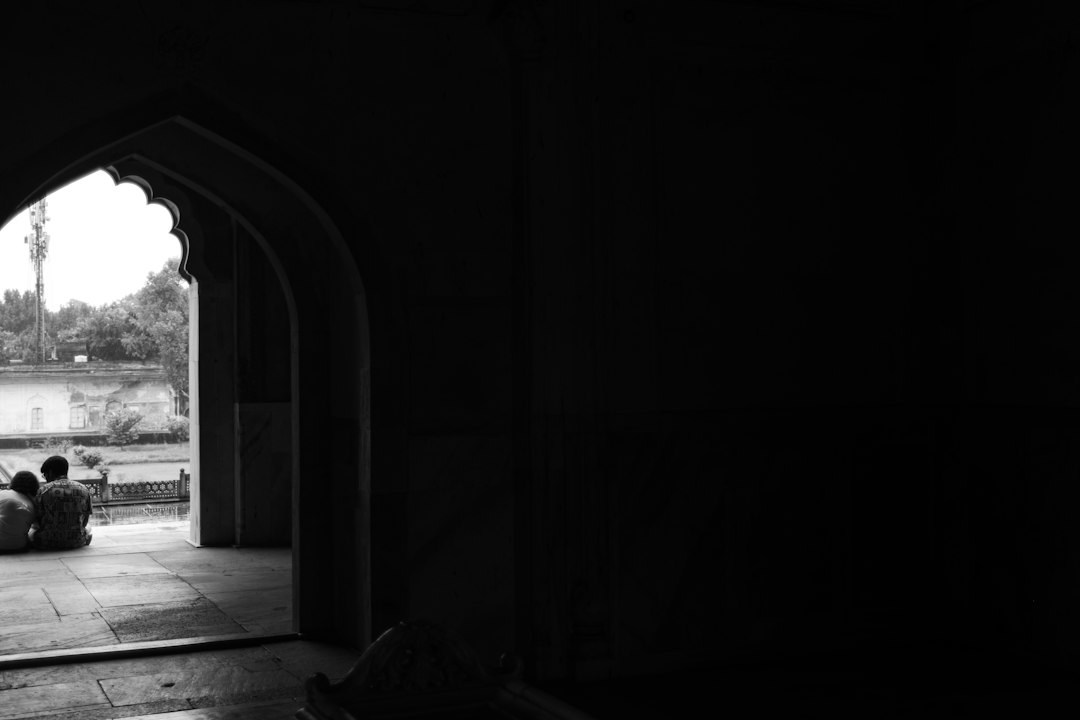
Photo by Zoshua Colah on Unsplash
Frame Within a Frame: How Cinema Uses Hidden Borders to Grip Your Attention
Every shot you see in a film is already a frame — a rectangle carved out of the world. But inside that rectangle, a director can build another frame: a doorway, a window, an archway, a gap in the trees, a car windshield. The subject sits inside both borders at once, and something quietly shifts in how you read the image.
This is frame within a frame, one of the oldest and most versatile tools in cinema composition. Most viewers never consciously notice it. That’s partly the point.
What It Is and Why It Works
Frame within a frame means placing your subject inside an element of the environment that creates a secondary border around them. The outer frame is the camera’s rectangle. The inner frame is built from the world of the film — architecture, light, bodies, objects.
The technique works on a basic perceptual level: concentric borders pull the eye inward to their center. A figure standing in a doorway has the camera’s edge, the door frame’s edge, and then the subject, all funneling attention. The viewer’s gaze follows that geometry without needing to be told.
But the real interest is what inner frames do to meaning. They don’t just isolate a subject. They contextualize one.
The Weight of Confinement
The most common use is to suggest that a character is contained or controlled by their environment. When someone is shown through a window, between prison bars, or inside a narrow doorway, the frame carries a physical suggestion: this person is hemmed in. The world presses around them.
This is different from simply putting a character in a small space. A close-up inside a cell still fills the screen. But shoot that same character through the cell door’s bars, and the geometry of confinement becomes visible — the audience literally sees the walls closing in.
Filmmakers use this to do emotional work before any dialogue lands. You don’t need a character to say they feel trapped if the composition has already said it.
Voyeurism, Distance, and Separation
A related use is to place the viewer in the position of an observer looking in on a private world. The peephole, the cracked door, the window from the street — these frames signal that we are watching something we perhaps shouldn’t be, or that we are fundamentally outside the world we’re looking at.
John Ford understood this as well as anyone. The shot that bookends The Searchers — a character viewed through a doorframe, surrounded by interior darkness, looking out into desert light — is one of the most analyzed compositions in American cinema precisely because the inner frame does so much work on its own. It holds the figure at the threshold between domesticity and wilderness, making him belong entirely to neither. No line of dialogue is needed. The geometry says it.
Mirrors as a Special Case
Mirrors are frame within a frame at their most psychologically loaded. A character glimpsed in a mirror gets doubled: the physical person exists alongside a reflection, and audiences have been trained by centuries of symbolic tradition to read mirrors as surfaces of truth, deception, or hidden selfhood.
When a director shoots a character in a mirror rather than directly, the image carries a question the audience may not consciously form but subconsciously feels: which version is real? That unease costs nothing to produce and lands reliably, which is why mirrors appear in so many films that deal with identity, self-deception, or fracture.
Building It Into the Frame
The technique lives in the collaboration between cinematography and production design. A director of photography can find an inner frame with a lens and an angle, but production designers build the doorways, arches, and corridors that make these compositions possible in the first place. The best uses feel inevitable — as if the environment naturally offered that border — rather than calculated.
That invisibility is the final thing to understand about frame within a frame. Its power is quiet. Viewers absorb the meaning without noting the mechanism. It works the same way in a silent film, a widescreen blockbuster, or a phone-shot indie because it operates below the level of style, at the level of perception. The eye follows borders. Cinema just learned how to plant them where they matter.