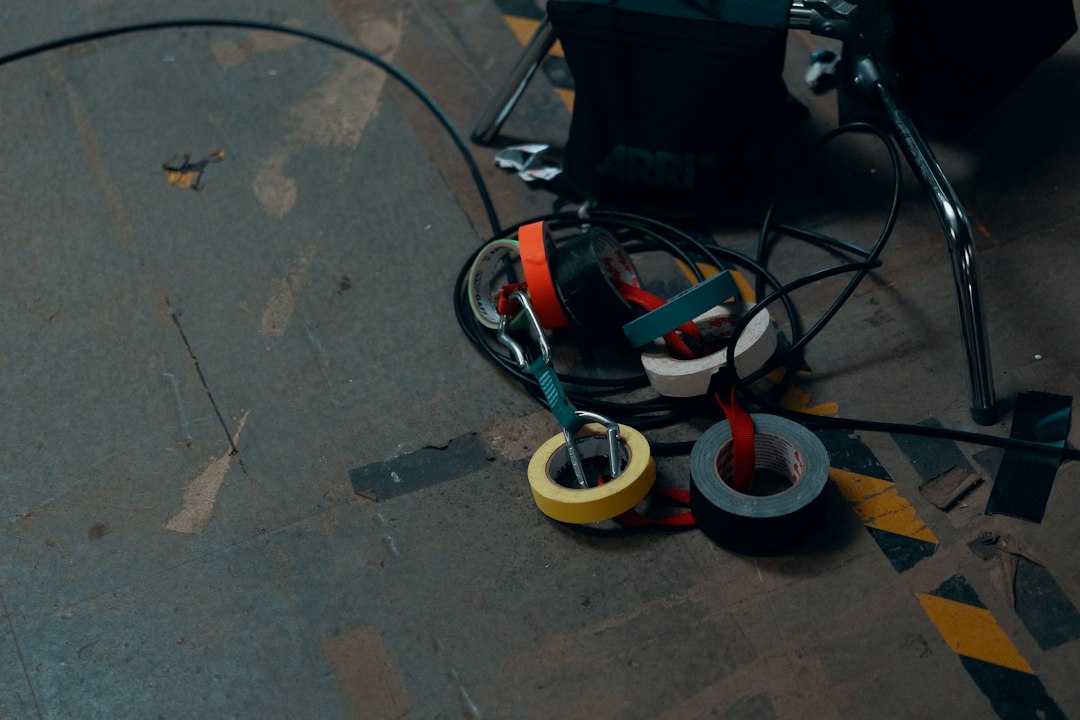
Photo by Ross Sneddon on Unsplash
Why Film Sets Use Marks and Tape on the Floor
Walk onto any film set and you’ll see strips of colored tape scattered across the floor. These aren’t random—they’re marks, one of the most fundamental tools in film production. They tell actors exactly where to stand, help camera operators frame shots consistently, and ensure focus pullers keep the image sharp. Without them, even simple scenes would require endless retakes.
The Focus Problem
Modern cinema lenses can create beautifully shallow depth of field, but that comes with a trade-off: the plane of sharp focus might be only a few inches deep. If an actor is supposed to be in focus at a specific moment and they stand six inches too far forward, their face goes soft. The focus puller—the crew member manually adjusting focus during a take—relies on marks to know exactly where the actor will be at each moment. They pre-measure distances, set reference points on their focus wheel, and trust that the actor will hit the mark. Miss the mark, and the shot is unusable.
Color-Coded Positions
When multiple actors share a scene, each gets their own color. Red tape for one actor, blue for another, yellow for a third. This prevents confusion during blocking rehearsals and keeps everything clear when crew members are calling out adjustments. If the director wants to change where someone stands, the tape gets moved or replaced. By the time cameras roll, everyone knows their spots.
The same system extends to camera positions. A dolly operator might have marks showing where the dolly starts, stops, or changes speed. A Steadicam operator might reference marks to maintain consistent framing across multiple takes. Even simple tripod setups get marked so the camera can be reset precisely if the setup needs to be broken down and rebuilt.
Why Not Just Wing It?
Inexperienced actors sometimes resist marks, thinking they’ll deliver a more natural performance if they move freely. But film isn’t theater. The camera doesn’t adjust to the actor—the actor adjusts to the camera. Lighting is set for specific positions. Lenses are chosen for specific distances. Background elements are arranged to support the composition. An actor who drifts even slightly can walk out of their key light, block another actor, or force the camera operator to reframe in ways that break visual continuity with other shots.
Professional actors treat hitting marks as a basic technical skill, no different from memorizing lines. They learn to feel the mark with their feet without looking down, maintaining eye contact and emotional continuity while their body memory handles the positioning. It becomes invisible to the audience but essential to the craft.
Beyond Tape
Sometimes tape isn’t practical. Outdoor locations with dirt, sand, or uneven terrain require different solutions. Crew members might place small sandbags, rocks, or natural features as reference points. On green screen stages, marks are even more critical because there are no environmental cues to help actors orient themselves. Every position must be precise so that composited elements align correctly in post-production.
Marks also extend to props. Furniture gets marked so it can be reset exactly between takes. Glasses, phones, and other hand props might have marks indicating where they should rest on a table. Continuity depends on this level of control—if a cup is three inches to the left in one take and three inches to the right in the next, the editor has a problem.
The colored tape on the floor represents something larger: the collaborative precision that makes filmmaking work. Every department depends on repeatability, and marks are the simplest, most reliable way to ensure that what worked in rehearsal works again when the cameras roll.