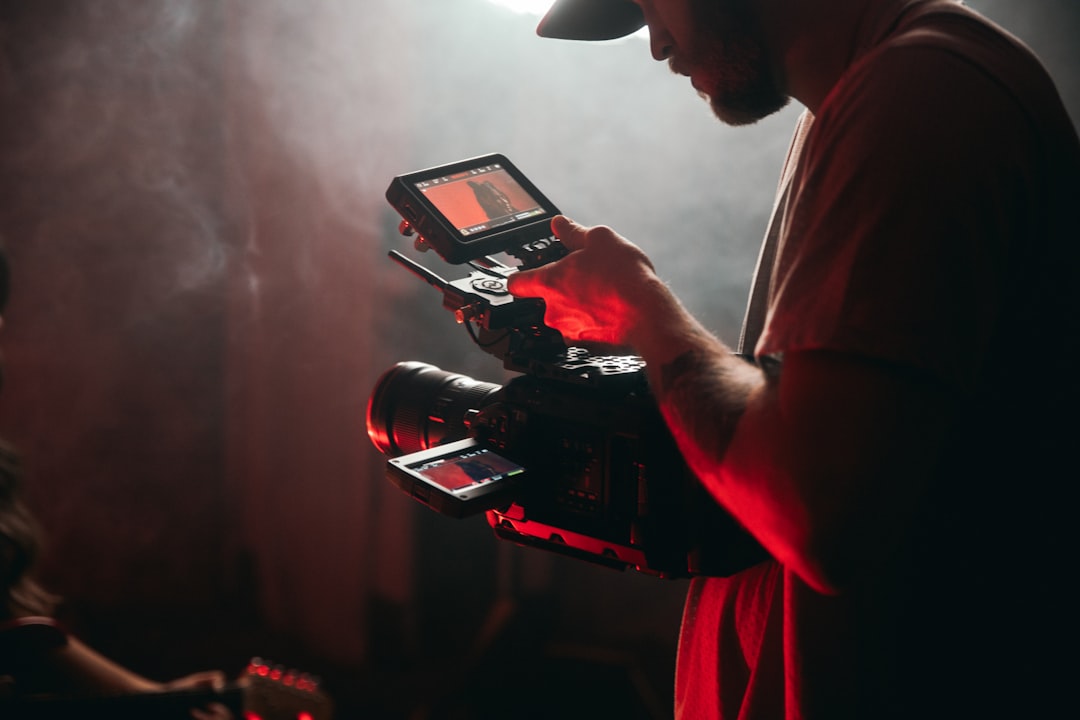
Photo by Kyle Loftus on Unsplash
Eye Trace: How Filmmakers Guide Your Gaze
Every frame of a film contains more information than any viewer can consciously process. A crowded street scene might include dozens of faces, moving cars, storefronts, and background action. Yet somehow, you always know exactly where to look. That’s not an accident—it’s the result of deliberate techniques filmmakers use to control eye trace, the path your gaze follows across the screen.
What Filmmakers Are Actually Controlling
Eye trace operates on a simple principle: human vision is drawn to specific visual cues in a predictable hierarchy. Movement trumps stillness. Light areas pull focus from dark ones. Sharp detail beats soft backgrounds. The human face, especially eyes, commands attention above almost everything else. Filmmakers layer these cues to create a visual path, ensuring that even in a complex frame, your attention lands exactly where the story needs it.
This control happens at every stage of production. A cinematographer might place a practical light source to brighten one actor’s face while leaving the rest of the frame in shadow. A production designer might use a red coat on the relevant character in a sea of neutral tones. An editor might cut just as a hand gesture begins, using the motion to anchor your eye at the start of the new shot.
Composition as a Road Map
The arrangement of elements within the frame creates invisible lanes for your eye to travel. A character positioned along a strong leading line—a hallway, a fence, a shaft of light—draws the eye naturally along that path. Blocking actors at different depths, with the foreground figure slightly out of focus, guides attention toward the sharp plane in the middle distance.
Negative space functions as a visual rest stop, giving the eye a place to pause before redirecting to the next point of interest. When a filmmaker centers a character in an empty frame, your attention has nowhere else to go. When that same character is framed to one side with open space on the other, your eye unconsciously anticipates something or someone entering that void.
Movement and Timing
Once the shot is composed, movement becomes the primary tool for steering attention. A static wide shot might contain ten people, but the moment one person stands, every eye in the audience follows. Editors exploit this by timing cuts to motion: a character turns their head in shot A, and the cut to shot B happens mid-turn, carrying your eye trace seamlessly into the new frame.
Camera movement adds another layer. A slow push-in gradually funnels attention toward the center of the frame, narrowing the viewer’s focus whether they realize it or not. A pan from one character to another explicitly directs the audience to shift attention, functioning almost like a pointed finger.
When Eye Trace Breaks Down
Poorly controlled eye trace is one of the most common sources of confusion in amateur filmmaking. If multiple visual cues compete—two brightly lit faces at opposite edges of the frame, both moving—the viewer’s eye doesn’t know where to land. The result is a vague sense that the shot “doesn’t work,” even if the viewer can’t articulate why.
Experienced filmmakers occasionally break eye trace deliberately, usually to create disorientation or overwhelm. A chaotic battle scene might layer conflicting motion and light sources to mirror a character’s confusion. But even then, the breakdown is controlled—specific moments of clarity punctuate the chaos, giving the audience a visual anchor before releasing them back into the storm.
The Invisible Craft
The paradox of eye trace is that when it works, it’s invisible. You never think, “That leading line guided my attention perfectly.” You simply follow the story, unaware that every glance, every shift in focus, was choreographed as precisely as the actors’ movements. The cinematographer, production designer, and editor collaborated to build a road map through the frame, and you followed it without ever seeing the signs.