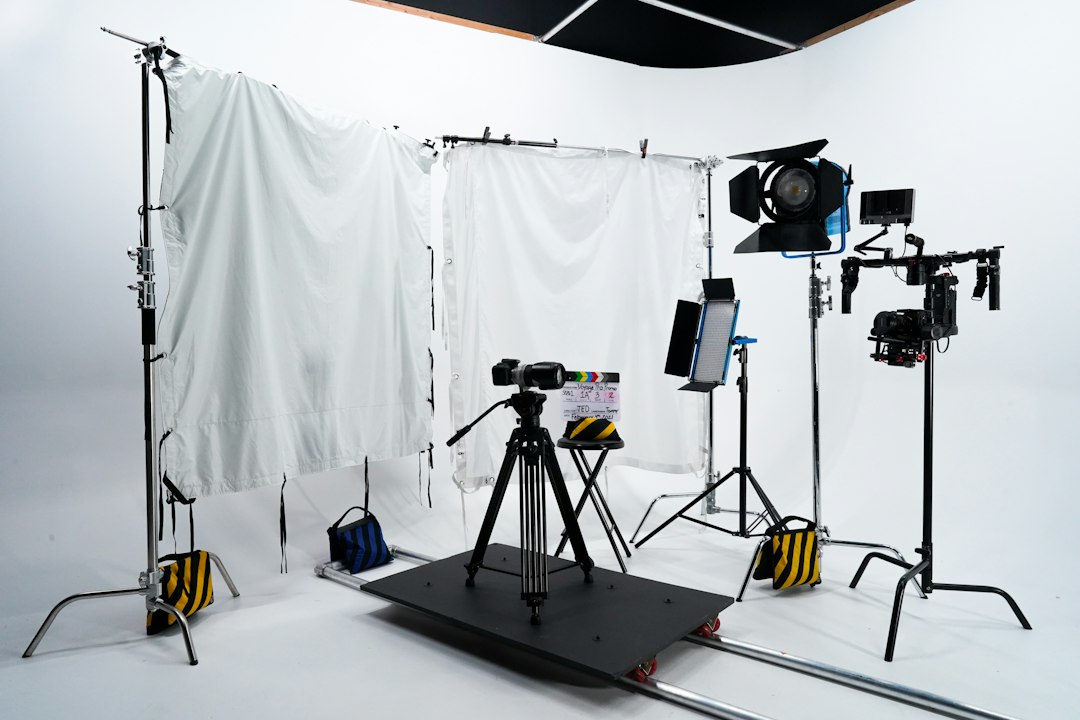
Photo by Voyage Pro on Unsplash
The Dolly Zoom: Cinema's Most Disorienting Illusion
The Dolly Zoom: Cinema’s Most Disorienting Illusion
There’s a moment most movie-watchers recognize even if they can’t name it: the subject stays locked in frame while the world behind them seems to heave forward or shrink away. The corridor stretches. The crowd compresses. Space itself looks wrong. Nothing in the shot actually moved — and that’s precisely the point.
This is the dolly zoom, and it’s one of cinema’s most effective tools for externalizing a psychological state through pure optics.
How It Works
The technique combines two camera movements that individually do very ordinary things, but cancel each other out in a strange way when run simultaneously.
When you zoom in on a subject, you magnify the image — both the subject and the background get larger. When you push a camera physically forward toward a subject, the subject grows larger too, but so does your sense of depth; the background appears to recede slightly relative to things closer to lens.
Now do both at once, but in opposite directions: zoom out while physically moving the camera toward the subject, or zoom in while pulling the camera back. The focal length change and the physical movement are calibrated to keep the subject the same apparent size throughout. The subject stays stable. The background, however, has nowhere to hide — it expands or contracts dramatically, because the perspective shift from the camera’s physical movement is no longer masked by a matching zoom. The relationship between foreground and background is unmoored.
Your eye registers the subject as fixed and rational. Your peripheral spatial sense registers the background as wrong. The brain receives two conflicting signals at once, and the result is a low-grade, vertiginous unease that is hard to source.
Where It Comes From
The technique is often called the Vertigo effect after Hitchcock’s 1958 film, where it was used to place the audience inside the protagonist’s acrophobic dread during a staircase sequence. The effect didn’t just illustrate the fear — it reproduced a version of it in the viewer. You don’t watch someone be afraid of heights; you feel the floor drop.
Steven Spielberg used it to devastating effect in Jaws, in a scene where a character on a crowded beach realizes a child has been attacked. The dolly zoom here isn’t about fear of falling — it’s about sudden, isolating shock. The world rushes away from him. Everyone around him keeps moving, oblivious, while he is locked in horror. The technique turns a crowded beach into a kind of tunnel. Both uses are famous, and both are correct: the same optical trick carries entirely different emotional freight depending on context.
What It’s Actually Saying
The dolly zoom is essentially a visualization of a psychological threshold — the moment a character crosses from one mental state into another. Revelation, dread, vertigo, grief, shock. It works because cinema is fundamentally about point of view, and this technique literalizes that: we see how a character sees, not just what they see.
That’s also why it fails when it’s used decoratively. Applied to a scene that doesn’t carry genuine psychological weight, it reads as a visual tic — the filmmaker reaching for a loaded gun and firing it at nothing. Audiences have internalized the association between this technique and a specific register of feeling. Breaking that contract just looks like style in search of substance.
The Modern Problem
The dolly zoom has become slightly victimized by its own recognizability. Because it appears in so many films, parodies, and video essays, savvy viewers can now identify the technique the moment it starts — which puts a pane of glass between them and the intended effect. When you think “oh, it’s a dolly zoom,” you’ve stepped outside the experience.
This doesn’t make the technique obsolete. It means filmmakers have to earn it more deliberately: the setup has to be strong enough that the audience is too invested in the character’s situation to notice the mechanics. The tool is still there. The threshold for using it well just keeps rising.
That’s how it should be. The best cinematic techniques become invisible when they’re working. The dolly zoom is most powerful when you feel the floor move before you know why.