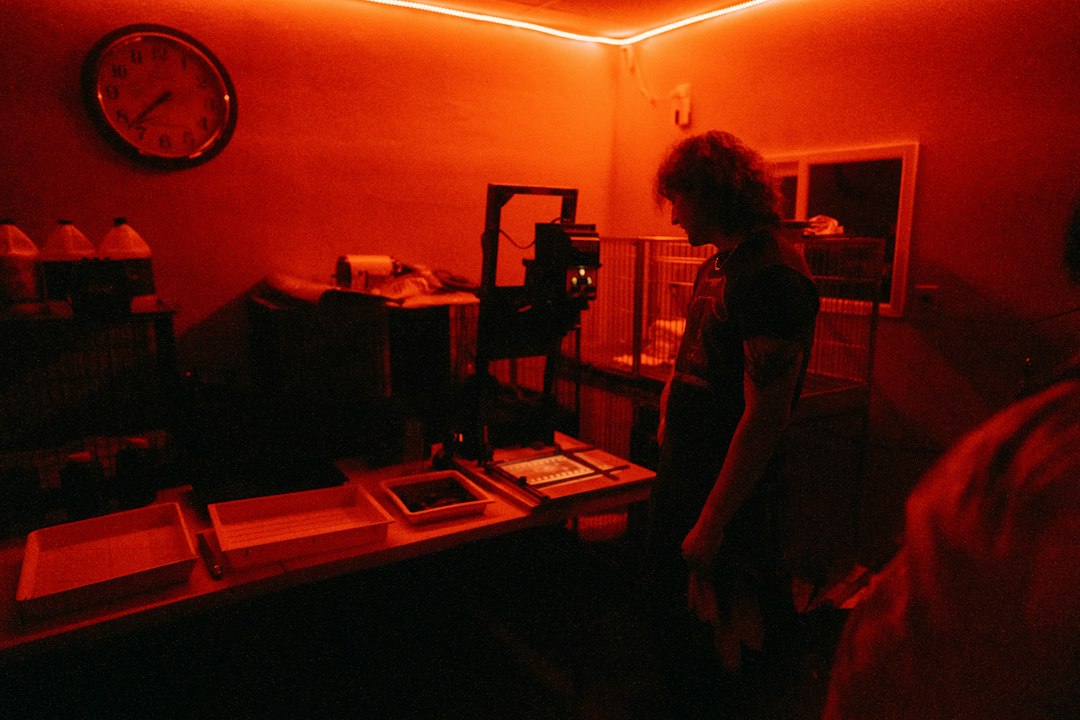
Photo by Francisco Gonzalez on Unsplash
The Developing Tray Effect: Why Movie Photos Appear Gradually
Every detective thriller and period drama seems to feature the same moment: a character stands in amber light, gently rocking a tray of chemicals while a photograph slowly materializes before their eyes. The image emerges like a ghost, details sharpening as the character watches. It’s atmospheric, it’s methodical, and for anyone who’s worked in a darkroom, it’s mostly wrong.
How Darkroom Development Actually Works
Real photographic development doesn’t look the way movies suggest. When you place an exposed sheet of photographic paper into developer, the image appears quickly—within seconds, not the languid minute films often depict. The process moves fast enough that timing matters: leave the paper in too long and it over-develops; pull it too soon and you lose contrast.
More importantly, the image doesn’t emerge in the neat, cinematic way films portray. It doesn’t fade in from nothing or build gradually from ghost to solid. Instead, the darker areas appear first, often quite suddenly, followed by the mid-tones and highlights. An experienced printer watches the highlights because those determine when to pull the print. The whole event is more abrupt than graceful.
Why Films Slow It Down
The cinematic version exists for narrative reasons. A photograph appearing instantly doesn’t give the audience time to process what they’re seeing. By stretching the reveal across twenty or thirty seconds, filmmakers accomplish several things at once.
First, it creates anticipation. If a character is developing evidence—a face, a license plate, a clue—the slow reveal lets tension build. The audience leans in, trying to identify details before they fully resolve.
Second, it allows reaction. A character can register surprise, horror, or recognition as the image emerges. Their face becomes part of the scene’s information. Pull the photo out instantly and you lose that emotional beat.
Third, it’s just more cinematic. The gradual materialization of an image from blank paper feels almost magical, a visual metaphor for truth revealing itself. It transforms a technical process into something dramatic.
The Convention Outlasts the Technology
What’s interesting is how persistent this visual trope remains even as darkrooms vanish from daily life. Younger audiences may never have seen photographic paper or smelled fixer, but they accept the slow-emerging photo as shorthand for “investigation underway” or “memory being recovered.”
Films set in contemporary settings rarely show darkroom scenes anymore—digital photography doesn’t provide the same visual opportunity. But period pieces, detective stories, and thrillers set in pre-digital eras lean on the device heavily. The image emerging in the developing tray has become cinema grammar, instantly readable even when chemically implausible.
Creating the Effect
When filmmakers do stage darkroom scenes, they face technical challenges. Real development happens under safelights that emit wavelengths photographic paper can’t detect—usually deep red or amber. These lights create atmosphere but don’t provide much illumination for cinema cameras.
The solution usually involves lighting the scene much brighter than a real darkroom, banking on the amber color to sell the location. The “developing” photograph itself is often practical—a real print going through a real chemical bath—but the timing is stretched. Some productions pre-soak prints or use diluted chemistry to slow the reaction. Others shoot multiple takes with prints at different stages of development, then edit them together to control the reveal.
In effects-heavy productions, the emerging image might be entirely digital, composited over footage of empty trays. This gives absolute control over timing and allows the image to resolve in whatever order serves the story—faces before backgrounds, eyes before everything else.
A Vanishing Ritual
The developing tray scene has become something rare: a filmmaking convention that depicts obsolete technology most viewers never experienced firsthand. It persists because it’s visually compelling and because it’s been used long enough to feel familiar. Like rotary phones or manual typewriters, the darkroom has become a period signifier, but unlike those objects, the process remains dramatic enough to warrant screen time.
When a contemporary film needs to show a character discovering an image, they swipe through a phone or click through files on a laptop. Functional, but visually flat. The photograph rising from the developer offered something cinema always values: a transformation you can watch unfold, a mystery materializing in real time, even if real time was never quite that slow.