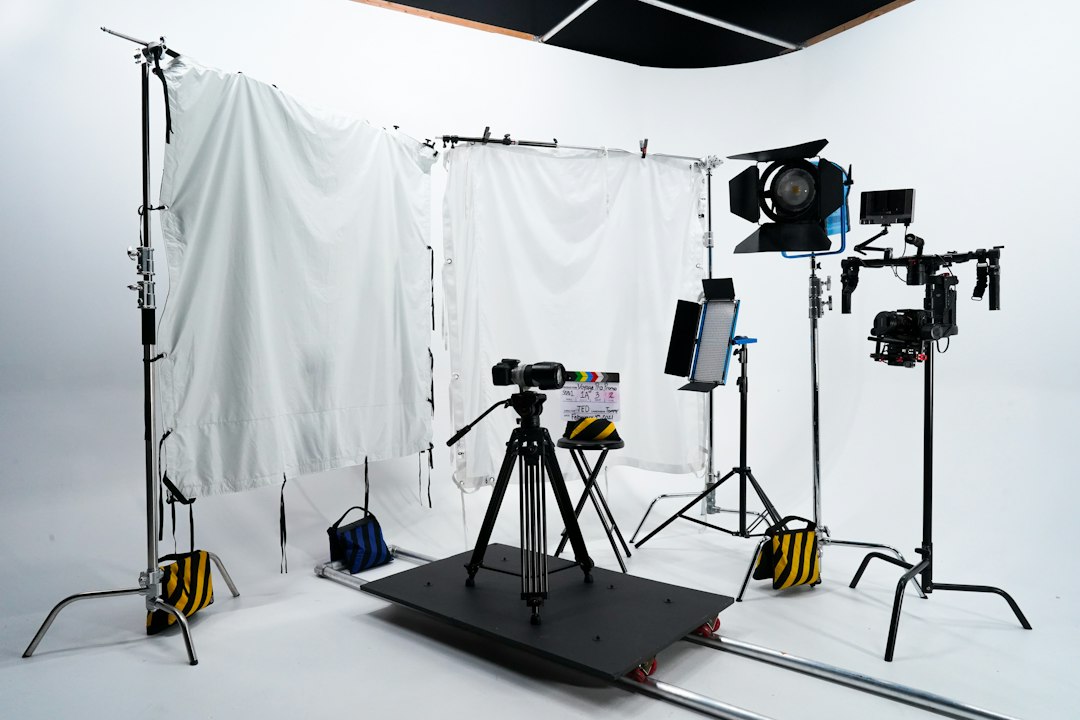
Photo by Voyage Pro on Unsplash
Green Screen and the Rise of the LED Volume: How Virtual Backgrounds Actually Work
Every filmgoer knows the image: an actor standing in front of a wall of vivid green, later replaced by an alien landscape or a burning city. Chroma key compositing has been a staple of blockbuster filmmaking for decades, but it’s also one of the most misunderstood techniques in the craft. It looks simple in theory and is brutally difficult in practice, which is exactly why the industry has spent the last several years trying to replace parts of it.
The Basic Trick
Chroma key works because a computer can isolate pixels of a specific color and cut them out, leaving a transparent hole that another image fills in. Green is used more often than blue because most cameras’ sensors are especially sensitive to green light, giving cleaner edges around hair and fine detail. Blue screens still show up when the subject is wearing green, or when a shot needs to avoid green’s tendency to spill onto skin and reflective surfaces.
The pulled-out footage is called a “key,” and the process of separating foreground from background is “keying.” It sounds mechanical, but a clean key depends on things a compositor can’t fix later: even, shadowless lighting on the screen itself, enough distance between actor and backdrop to avoid green light bouncing onto the performer, and a camera position that’s locked down or precisely tracked so the digital background can move in sync with it.
Why Actors Hate It
Performing against a green screen is one of the least forgiving jobs in acting. There’s no environment to react to, no real light source to squint against, no physical set piece to lean on. Directors and cinematographers try to compensate with reference monitors, pre-visualized animation, or simply describing the scene in detail, but the actor is still, in a very real sense, performing an act of imagination in a vacuum. Eyelines are especially tricky: if a creature or object will be added in post, someone on set usually holds a marker or tennis ball on a stick at the right height so the actor has something concrete to look at.
This is also why green screen work is often singled out in interviews as exhausting in a way physical sets aren’t. The emotional labor of imagining a world that isn’t there, shot after shot, take after take, adds up differently than reacting to a practical environment.
The Volume Changes the Equation
The biggest recent shift in this space is virtual production using LED volumes: massive curved walls and ceilings of LED panels that display a real-time, computer-generated environment instead of a flat green screen. A game engine renders the background live, and as the camera moves, the perspective on the LED wall shifts to match, creating correct parallax without a compositor doing it after the fact.
This solves several problems at once. The actor can actually see the environment they’re supposedly standing in. The lighting from the screen itself illuminates the set and reflects correctly in eyes, skin, and metal surfaces, which chroma key could never do convincingly. And because much of the final image is captured in camera, some shots need far less post-production compositing.
It isn’t a wholesale replacement, though. LED volumes are expensive to build and operate, they work best for contained environments rather than sprawling exteriors, and the resolution of the wall can create moiré patterns or focus issues if the camera gets too close. Green screen remains cheaper, more flexible for wildly different shot types, and often the right choice for smaller productions or effects that need to be built and refined slowly over months rather than rendered live on the day.
A Tool, Not a Shortcut
What both techniques share is that they only work when the fundamentals of cinematography are still respected: matched lighting direction, believable shadow, consistent color temperature, and a camera move that makes physical sense. No amount of digital background, real-time or composited, will sell a shot if those basics are off. The technology has changed dramatically over the past twenty years, but the eye still needs the same things it always has to believe what it’s looking at.