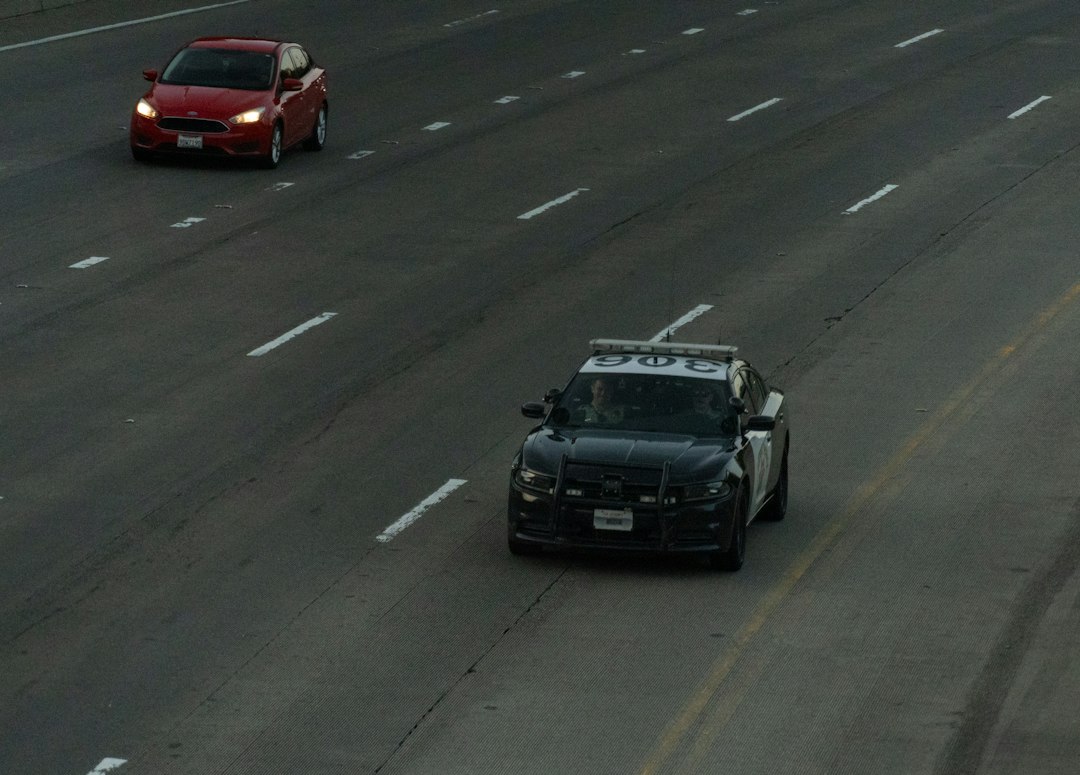
Photo by Nishat Samadzai on Unsplash
Why Movie Chase Scenes Keep the Camera on One Side
When a character runs down a hallway or a car speeds through city streets, the camera has to make a critical choice: which side of the action to observe from. This decision determines whether the audience can track where everyone is going—or whether the sequence becomes spatially incoherent.
The principle is an extension of the 180-degree rule, applied to movement through space. If a character is running left to right across the frame, every subsequent shot should maintain that direction until something in the story justifies a change. Break this consistency carelessly, and the audience loses their mental map of the chase.
The Camera Takes a Side
During a pursuit, the director of photography and camera operators position themselves on one side of the action’s path. If a getaway car is speeding north on a street, cameras stay on the east or west side, but not both interchangeably. This keeps the car moving in a consistent screen direction—either left-to-right or right-to-left—across every cut.
The same logic applies whether it’s a foot chase through alleyways, a horseback pursuit across open terrain, or a starship battle through an asteroid field. The viewer builds a spatial model in their mind: pursuer behind, pursued ahead, obstacles in between. Maintaining camera side preserves that model shot by shot.
When coverage is planned, multiple cameras often run simultaneously, but they’re clustered on the same side of the action line. A camera on the sidewalk, another on a rooftop, and a third in a tracking vehicle can all capture different angles and scales, but they respect the established direction of travel.
When and Why to Cross
Filmmakers do cross to the opposite side, but with intention. A deliberate camera flip signals that the chase has reversed, the hunter has become the hunted, or the geography has fundamentally changed. The moment of crossing is often covered by a neutral shot—something head-on, directly overhead, or so close that direction becomes ambiguous—so the transition doesn’t feel like a mistake.
Some action directors cross the line inside a single shot using camera movement. A whip pan that follows a character making a sudden U-turn, or a crane that arcs over and around the action, reorients the viewer with the camera itself rather than through cutting. The movement becomes the storytelling.
Other sequences embrace intentional disorientation, especially when characters are lost, panicked, or outmatched. Rapid cuts from inconsistent angles create confusion, mirroring the character’s experience. But this only works as a deliberate choice against an established baseline of spatial clarity.
The Invisible Geography of Action
The reason this matters is that action sequences are exercises in spatial problem-solving. The audience needs to know who is where, who has the advantage, and what obstacles or opportunities are coming. Screen direction is the simplest, most efficient way to communicate that information.
A chase is a race through space with rising stakes. If the pursued is moving left to right and suddenly appears moving right to left without explanation, the brain has to stop and recalibrate. That momentary confusion breaks the tension that the sequence is working to build.
This doesn’t mean every chase needs to be geographically literal. Filmmakers routinely cheat locations, compress distances, and rearrange streets to serve the drama. What matters isn’t real-world accuracy but internal spatial logic. As long as the screen direction remains consistent, the viewer’s sense of pursuit and progress stays intact.
Respect the side, and the chase builds momentum. Cross it carelessly, and even the most expensive action sequence can feel flat and hard to follow.