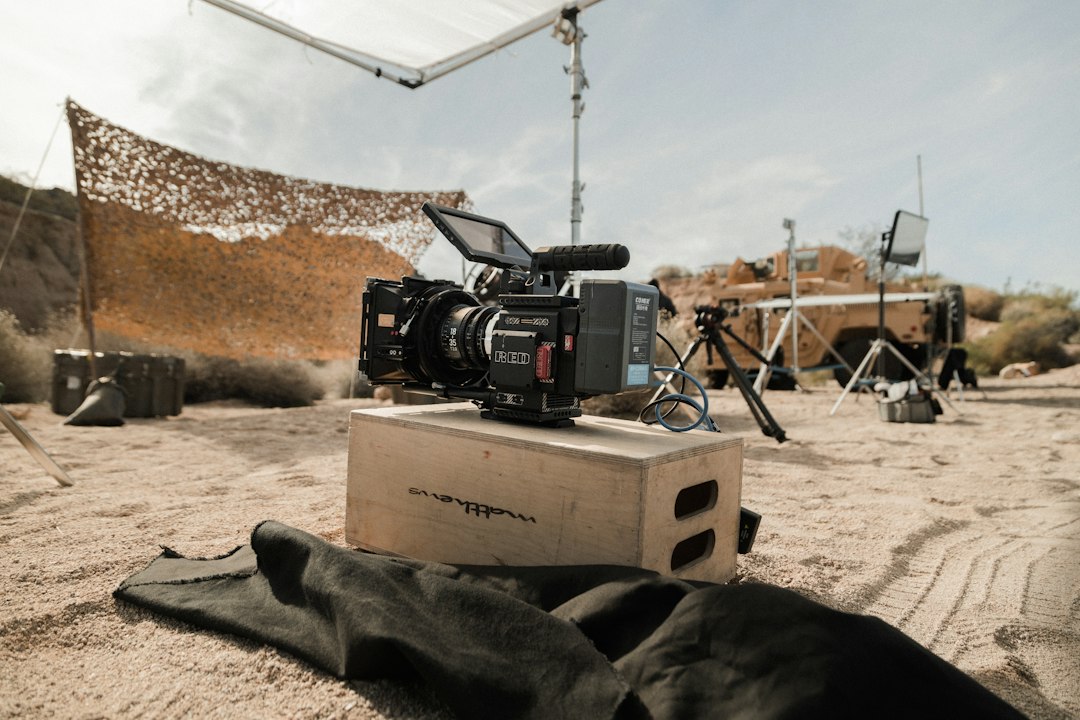
Photo by Jakob Owens on Unsplash
Why Film Sets Use Apple Boxes
Walk onto any professional film set and you’ll find them stacked in corners, tucked under dollies, or positioned just out of frame: apple boxes. These simple wooden crates have become as essential to filmmaking as cameras and lights, solving dozens of practical problems that arise during production.
What Is an Apple Box?
An apple box is a sturdy wooden crate, typically made from pine, measuring 20 inches long by 12 inches wide. What makes them uniquely useful is that they come in a family of standardized sizes, each with its own nickname based on height. A “full apple” stands 8 inches tall, a “half apple” is 4 inches, a “quarter apple” is 2 inches, and a “pancake” is just 1 inch. This modular system lets crew members stack and combine them to reach almost any height needed on set.
The name itself has disputed origins. Some claim they were originally used to ship apples in orchards, while others suggest the dimensions were simply standardized by a grip equipment manufacturer decades ago. Regardless of etymology, the apple box has remained largely unchanged for generations because the design works.
Why Wood and Why These Dimensions?
Film sets demand equipment that can take punishment. Apple boxes get stood on, sat on, stacked ten high, and moved hundreds of times per day. Wood provides the right balance of strength, weight, and cost. Unlike metal cases, wooden boxes won’t dent grip equipment or damage expensive camera gear when they inevitably bump into things during a fast setup change.
The specific dimensions aren’t arbitrary. At 20 by 12 inches, an apple box provides a stable platform large enough for an actor to stand on comfortably, but narrow enough to hide behind a piece of furniture or squeeze into tight shooting spaces. The standardized sizing means every grip on every set speaks the same language. Call for a half apple and you’ll get exactly 4 inches of lift, no measuring required.
The Hundred Uses
Ask a gaffer or key grip to list everything apple boxes do on set and you’ll be there a while. They raise actors to match eyelines when heights don’t align naturally. They become impromptu seats for crew between takes. They protect delicate equipment during transport. They prop doors open, stabilize light stands on uneven ground, and create levels for product shots.
Cinematographers use them constantly for camera height adjustments that are too small for a full riser but too large to ignore. Directors of photography will often call out “add a pancake under the dolly” or “pull that half apple” to fine-tune a shot by mere inches. In close-up work, those small adjustments make the difference between a flattering angle and an awkward one.
The apple box also serves as Hollywood’s unspoken height equalizer. When actors of different heights share a frame and the shorter performer needs to match the taller one’s eyeline, apple boxes provide a discrete, stable solution. It’s so common that being given an apple box to stand on carries no stigma whatsoever among professionals.
Why Not Just Use Anything?
Productions could theoretically use random crates, storage bins, or platforms cobbled together from hardware store lumber. But standardization matters enormously when you’re working under time pressure with a crew that might include dozens of departments. Everyone from the camera team to the lighting crew to the art department knows exactly what “bring me two full apples and a half” means. There’s no guessing, no measuring, no mismatch between what was requested and what arrives.
Apple boxes also nest inside each other for efficient storage and transport. A truck can carry a few dozen without them taking up excessive space, and they stack safely without shifting during transit. These practical considerations add up over the course of a production that might span months and multiple locations.
The apple box represents the kind of unglamorous infrastructure that makes professional filmmaking possible. It’s not innovative or high-tech, but it’s precisely engineered for the chaos and improvisation of a working set. That’s why after decades of technological revolution in cameras, lights, and post-production, the wooden apple box remains exactly the same.