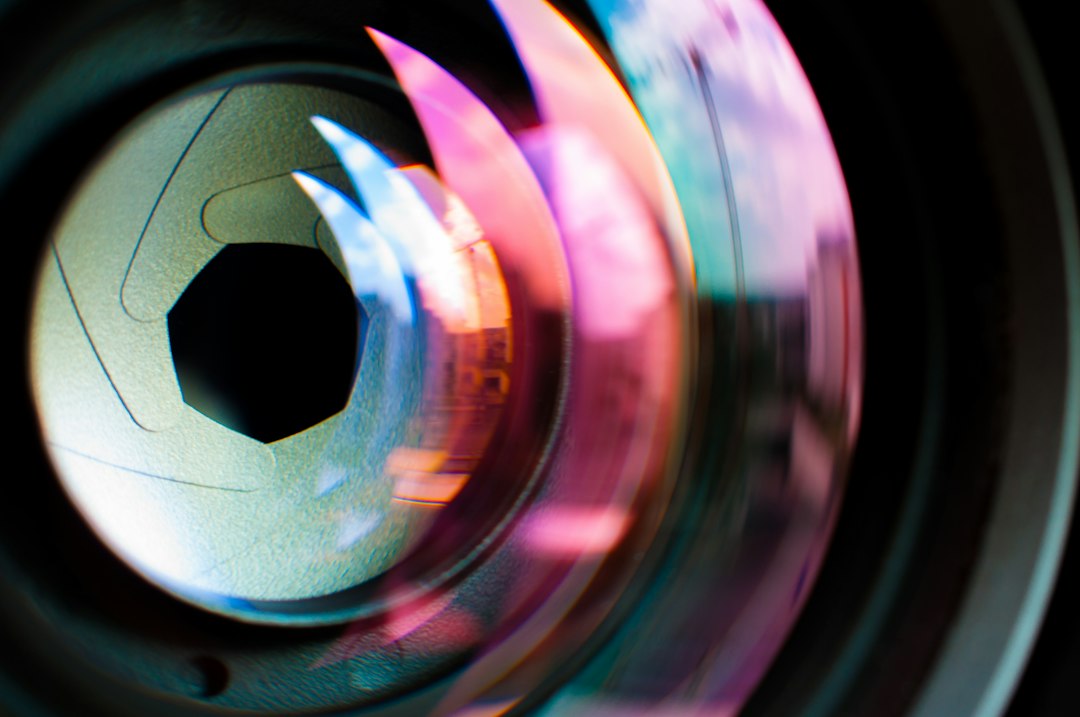
Photo by Agence Olloweb on Unsplash
Why Anamorphic Lenses Still Define the Look of "Big" Movies
If you’ve ever watched a trailer and thought “this looks expensive” before a single shot of a set or a star, there’s a decent chance an anamorphic lens is doing some of that work. Horizontal streaks of light stretching across the frame, ovoid out-of-focus backgrounds, a subtle bend at the edges of the image — these aren’t accidents. They’re the signature of a lens design that’s been shaping what “cinematic” means for seven decades.
What Makes a Lens Anamorphic
A standard spherical lens captures an image evenly in all directions. An anamorphic lens squeezes the image horizontally as it’s captured, cramming a wider field of view onto the same piece of film or sensor. In projection, that squeeze gets undone with a matching unsqueeze, stretching the image back out into a wide, panoramic frame. The lens is doing optical compression on the way in so the format can deliver width without needing a physically wider piece of film.
That squeeze-and-stretch process is also why anamorphic footage has such a distinct personality. Because the lens is bending light unevenly across two axes instead of one, it introduces optical quirks that spherical lenses don’t have: elongated bokeh, curved flares, and mild geometric distortion toward the edges of the frame.
Born as a Widescreen Fix
Anamorphic optics found their way into mainstream filmmaking in the early 1950s, when the studio system was scrambling to give audiences a reason to leave their homes and their new television sets. Wider, more immersive frames were part of the pitch, and anamorphic lenses offered a way to get a much wider aspect ratio without redesigning cameras and film stock from scratch. The format that resulted became closely associated with prestige and scale for decades afterward, and that association never really faded even as the technical reasons for it did.
The Optical Signature Everyone Recognizes
The specific look people associate with anamorphic glass comes down to a handful of traits. Out-of-focus points of light stretch into ovals rather than staying circular, giving backgrounds a softer, almost painterly quality. Bright light sources produce long horizontal flares instead of the starburst pattern typical of spherical lenses. There’s often a gentle curvature at the vertical edges of the frame, sometimes called the “anamorphic bend,” which shows up when a straight vertical line, like a doorframe near the edge of the shot, appears to lean slightly.
None of these are flaws in the modern sense. They’re the reason cinematographers still request specific vintage anamorphic lens sets by name, sometimes preferring older, less “corrected” glass precisely because the imperfections read as more organic and less clinical than what contemporary spherical lenses produce.
Why the Format Persists
Digital cameras don’t need anamorphic squeezing to capture a wide image anymore. Sensors can be built at whatever aspect ratio a production wants, and cropping to widescreen in post costs nothing. So the continued use of anamorphic lenses today is almost entirely an aesthetic choice rather than a technical necessity. Filmmakers reach for it because the optical texture carries connotations built up over generations of widescreen epics, and because that specific combination of shallow-feeling depth, elongated bokeh, and horizontal flare still reads to audiences, even subconsciously, as “big.”
The Digital Imitation Problem
Because real anamorphic glass is expensive, heavy, and finicky to focus, visual effects and color software now offer ways to simulate the look digitally: synthetic flares, stretched bokeh filters, edge distortion added in post. These tools can get close, but the imitation tends to be more uniform and predictable than what actual glass produces, since real anamorphic distortion varies with focal length, aperture, and distance to subject in ways that are hard to fake convincingly. That gap is part of why productions with the budget for it still rent the real lenses rather than trust the effect entirely to post-production.
The next time a flare stretches clean across the screen instead of bursting into points, that’s not a filter someone dropped on top of the image. It’s a piece of optical engineering built to solve a problem in 1953 that still shapes how movies are asked to feel today.