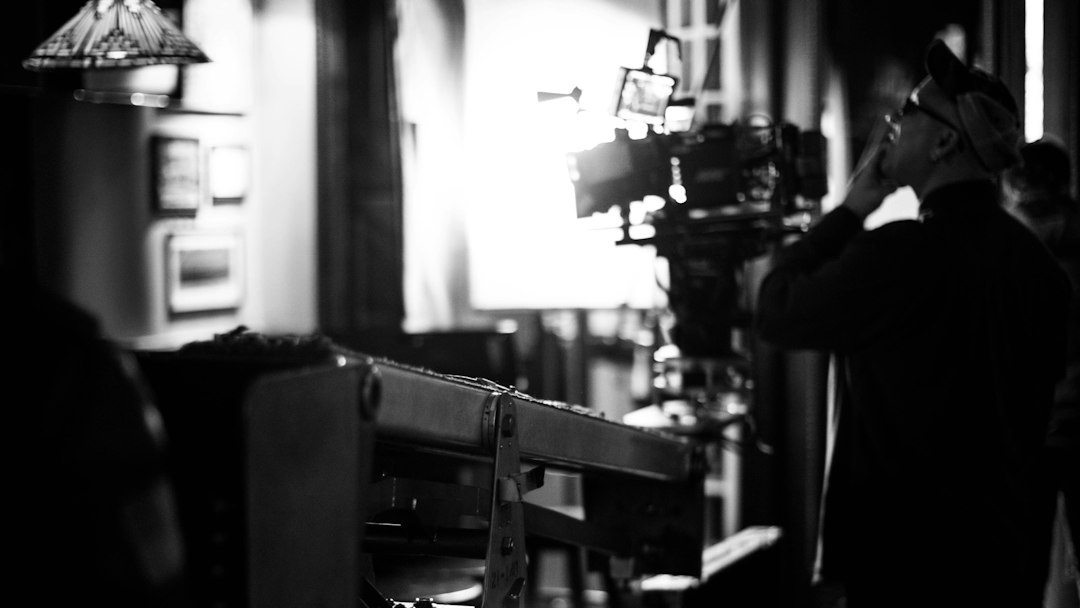
Photo by Revolver Creative Company on Unsplash
The 180-Degree Rule: Cinema's Invisible Law of Space
When two characters face each other in a scene, you always know which one is on the left and which is on the right. You track their sightlines. You feel the distance between them. None of this requires any conscious thought — it simply happens. The tool making that possible is one of film grammar’s oldest and least-discussed conventions: the 180-degree rule.
The Line Nobody Draws
Imagine two characters at a table. Between them, invisible but absolute, runs an axis — the line of action. The 180-degree rule dictates that every camera position in the scene must fall on the same side of that line. Cross it, and the characters appear to switch sides. The person who was looking left is suddenly looking right. For a split second, the viewer’s spatial map collapses.
Film schools teach this as a rule to obey. The better way to understand it is as a description of how humans naturally track space. We build mental models of where things are relative to each other, and cinema works by feeding and managing those models. The 180-degree rule is just the formal articulation of that mental architecture.
Why Your Brain Cares
Screen direction is one of those perceptual systems so deeply wired that audiences respond to violations before they understand them. In a chase scene, the pursuer runs left to right. If the camera cuts to the opposite side and suddenly they’re running right to left, the chase reads momentarily as a retreat — even if nothing in the shot has changed except the camera angle.
Editors rely on this constantly. Matching screen direction across cuts is what makes a chase feel continuous, a conversation feel grounded, a crowd scene feel coherent. When editors talk about “crossing the line” as a problem to fix in the edit, they’re talking about protecting that mental map. The alternative — coverage with no consistent spatial logic — produces a scene that shows the right events in the right order but leaves audiences feeling vaguely unsettled without knowing why.
The Productive Violation
If the rule creates stability, breaking it creates the opposite — and that’s useful.
Directors use axis crossings deliberately to signal disorientation, psychological fracture, or a shift in power. When a character’s world is coming apart, when a scene is supposed to feel destabilizing, a crossed axis can do that work faster and more subliminally than any line of dialogue. The viewer feels the wrongness before they process it consciously.
Action filmmaking sometimes exploits the rule’s dissolution as deliberate sensory overload — cut fast enough, cross the axis enough times, and spatial coherence becomes impossible to maintain. The viewer stops tracking geography and surrenders to chaos. Whether that’s a good effect depends entirely on what the film is going for.
More controlled violations tend to be more interesting. A scene that has maintained rigorous spatial logic throughout, then crosses the axis at a single moment of confrontation or revelation, can be quietly devastating. The viewer’s map has been carefully constructed, so breaking it registers as genuinely disruptive rather than just muddled.
Grammar, Not Law
The 180-degree rule belongs to a broader system sometimes called cinematic grammar — the conventions of cutting, framing, and staging that create shared meaning between filmmakers and audiences. Like actual grammar, it’s most visible when broken. And like actual grammar, fluency means knowing when the break is expressive and when it’s just a mistake.
The useful question for any director, editor, or attentive viewer isn’t “was the line crossed?” but “what did crossing it do?” Spatial confusion with no payoff is just confusion. Spatial confusion that arrives at exactly the right moment, in service of exactly the right feeling, is invisible craft.
The 180-degree rule isn’t really a rule. It’s a contract between the filmmaker and the viewer’s sense of where things are — and like any contract, its value lies in understanding what happens when it’s honored, and what becomes possible when it isn’t.